


The Proper Storage of Your Projector

The movie has faded to black. The final lines of credits, all the official seals and Roman numerals, have rolled past and up out of sight. The crowd is starting to lurch upright and shake out the pins and needles in their legs. From the sleepy smiles on the faces that pass you, it would seem that everyone had a textbook enchanting evening of outdoor cinema. Congratulations: your backyard Super Bowl party / outdoor video game competition / movie in the park was a rousing success. But don't start polishing your laurels just yet — you have to make sure all this outdoor cinema equipment is properly broken down and stored away for next time, in particular that precious projector.
Don't be too hasty
If you're too hasty when packing, your projector could sustain long-term damage and fail much sooner than you'd want. So the first thing to do is take a step back and let it cool down. When a projector is actively running it can reach pretty hot temperatures — that's why projectors have fans. If you yank the plug out of the wall and shut it down completely before the fans have done their job, the components can warp or be damaged by the heat; it could even break the lamp filaments in the light source or the wiring in your console. Let the fans cool the projector for at least two minutes. Since you'll be waiting anyway, you might as well make yourself useful — help people pick up trash or deflate the screen.
Wrapping up
Once the projector has cooled, you can start unplugging cables. Remember that AV cables have sensitive electronics inside: typically a central conductor and a braided shield around it, each of which needs to be coiled in its own direction to keep working well. You can't just coil an AV cable tight around your elbow like an extension cord. For speaker cables, power cables, or anything you plug into your projector, use the over/under method, which lets the cable's interior coil in a proper figure-8. Lay the cable out flat, pick up one end, and make a loop in the direction of the cable's natural coil. Before the second loop, twist the remaining line with your fingers so the inner wiring runs the correct way. Repeat until the cable is completely wrapped.
Carrying cases
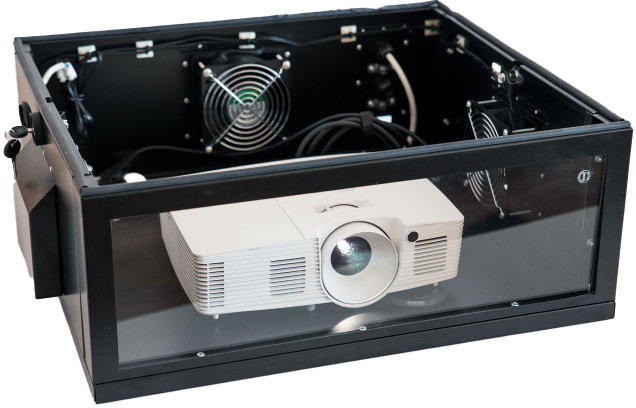
If you put on outdoor cinema events regularly, it's worth having a proper carrying case for your projector and cables. Some people hold on to the original box and styrofoam, but cardboard tears easily, styrofoam gets lost, and anyone who's tried to repack something exactly the way the manufacturer did knows it's a fool's errand. Get a nice foam-padded case with dedicated compartments for your projector, cables, and anything else you need on hand. A big part of running a successful event is preparation — and proper preparation actually begins at the end of the previous event. If you don't take down and store your equipment properly, you're only adding a hitch to next time's setup. Do your future self a favor and store everything the right way.
Hi Cheri! In normal conditions where you do not predict that someone could hit your projector accidentally bubble wrap is excessive. Storing your projector in a box is a good idea so it does not collect dust. Wrapping your screen in plastic after the event is unrecommended because it’ll prevent moisture to escape from your screen
Hi I was just wondering if It’s recommended if you keep a projector stored wrapped up in bubble wrap in a box. & also keeping a rolled up screen wrapped up in plastic Thanks