


How to Choose a Projector for Your Inflatable Screen
Updated 2026 · Open Air Cinema — a quick companion to our full projector buyer's guide.
When you buy an outdoor movie system, it can serve you for years, because the components are upgradable. The projection surface hasn't really changed in a century — but projectors improve every year, so the projector is the part you'll refresh over time.
Resolution: 1080p is still plenty outdoors
An outdoor crowd usually sits far enough back that 4K detail isn't visible — past roughly one screen-width, native 1080p and 4K look much closer than the spec sheet suggests, and most sources are 1080p or compressed streaming anyway. 1080p remains a sensible choice for an outdoor projector. If you do want 4K, note that most projectors in this class are pixel-shift (DLP “XPR,” Epson “4K PRO-UHD”) rather than a native 4K chip — fine at normal distances, but judge by how the image is actually formed.
Brightness: size lumens to the screen, and demand honest ones
Inflatable screens are big, so brightness is the spec that matters most. On a dark site, aim for roughly 15–20 honest ANSI/ISO lumens per square foot of screen, with headroom for stray light. For a typical mid-size inflatable in full dark that lands around 4,000+ lumens; a large park screen needs far more. Insist on an ANSI or ISO 21118 figure — “LED lumens,” “light-source lumens,” and “lux” are marketing units that can overstate real brightness many times over. (Our full guide has a lumens-by-screen-size table.)

Light source: laser is the default in 2026
For frequent use, laser is the easy call: instant on/off for fast teardown, ~20,000–30,000 hours (rated to 50% brightness), and it holds up better than a bulb that fades and needs replacing. A lamp projector is still a fine, cheaper option for occasional use — just respect the cool-down and keep a spare bulb. (Laser mainly saves you maintenance and warm-up time; it isn't automatically lower-wattage, so check the rated draw when sizing power.)
Throw & placement: standard throw for big, swaying screens
Extra features — lens shift, wider zoom, more inputs — keep getting cheaper, and lens shift is worth having: it squares the image optically with no loss of quality, unlike digital keystone, which throws away pixels and softens the picture. For inflatable screens, favor standard throw: the screen is large and sways in the wind, and short or ultra-short throw is finicky outdoors — most ultra-short-throw projectors can't fill much past a ~150-inch diagonal. Always check the maximum projected image size against your screen before buying.

Weather: plan for dew
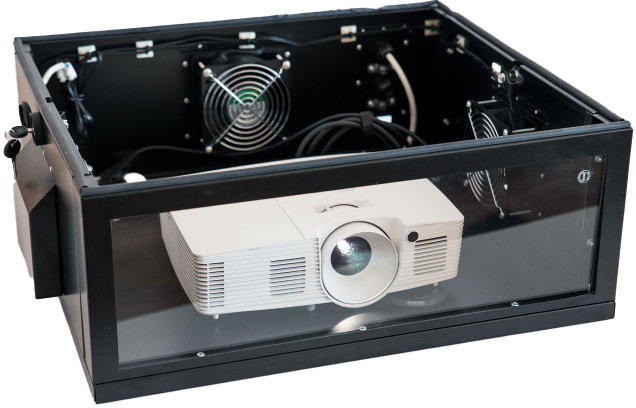
Projectors aren't weatherproof, and the major manufacturers (Optoma, Epson, Panasonic, Canon) don't rate them for outdoor use. Outdoors, dew is the real killer — run the projector under a tent, keep it off wet grass, and never leave it out overnight. After 20+ years of outdoor screenings, our pick for Open Air Cinema complete systems is Optoma, and we've also seen Panasonic units hold up well.
The short version
For a typical inflatable screen in full dark: a Full HD (or pixel-shift 4K) laser projector around 4,000+ honest ANSI lumens, sized up for bigger screens, with lens shift and enough inputs for your gear. For the full lumens math, throw-ratio help, and 2026 model picks by tier, read How to Choose a Projector for Outdoor Cinema — and if you'd like help speccing a complete outdoor movie system, get in touch.